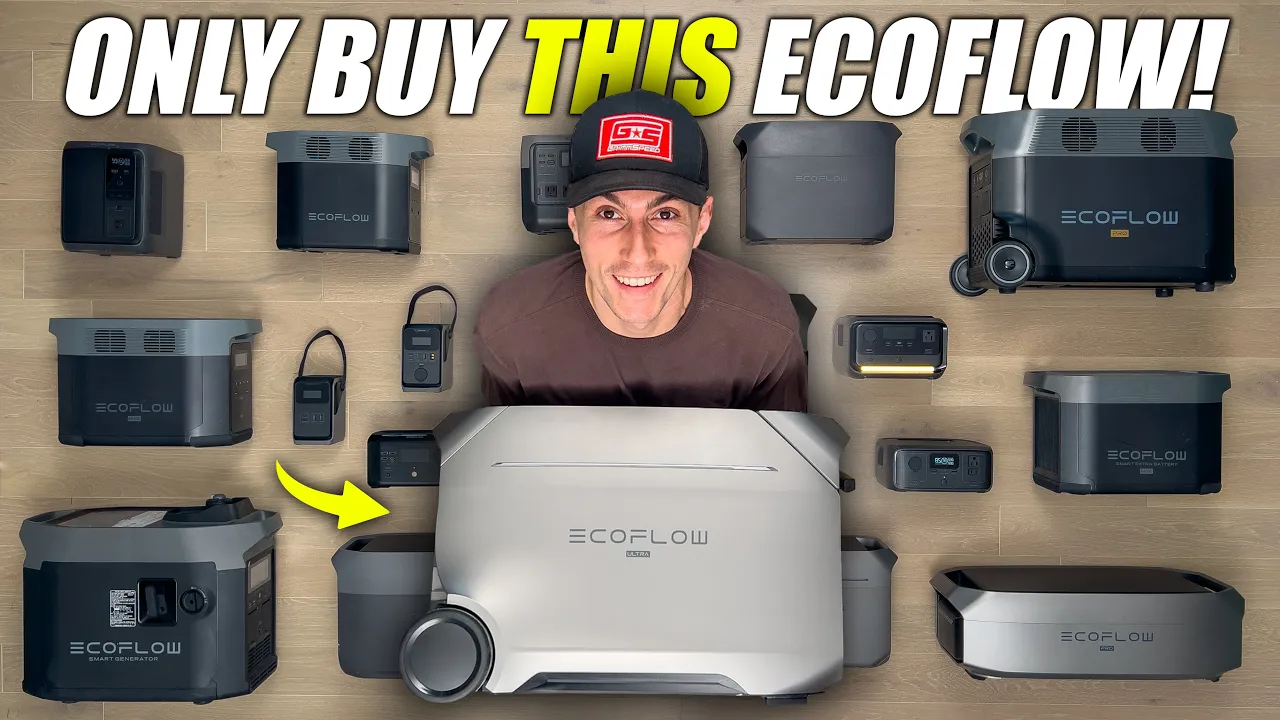
EcoFlow has been all gas and no brakes lately when it comes to releasing new power stations. On paper, more options and more innovation sound like good things. In reality, the EcoFlow portable power station product line has become one of the most confusing messes in the portable power space.
Power stations are already a type of product that the average person is just starting to become familiar with, but instead of simplifying things, EcoFlow has gone in the opposite direction. Over the past year alone, they’ve released dozens of models with overlapping names, similar designs, and wildly different capabilities. The result? People constantly ask us which EcoFlow power station they should buy, and honestly, we’re not surprised so many people are feeling confused.
To help clear things up, we’re breaking down EcoFlow’s entire lineup, explaining what each category is supposed to be for, where the confusion comes from, and which EcoFlow portable power station actually makes sense to spend your money on.
The biggest issue with EcoFlow isn’t product quality, it’s the way they name and organize their power stations.
The truth is, the EcoFlow brand is one of the most reputable and well-known names in portable power. However, they’ve developed an annoying habit of releasing new products that sound like upgrades, but aren’t actually improvements over the models they seem to be following.
A perfect example is the EcoFlow DELTA 3 Max, which you’d naturally assume is better than the older DELTA 2 Max. In reality, the DELTA 2 Max is still the better power station unless you move all the way up to the DELTA 3 Max Plus. Feeling confused? Us too.
Instead of improving one model at a time, EcoFlow keeps releasing multiple versions of the same idea. That’s how you end up with situations where there’s just two versions of the DELTA 2, but six versions of the DELTA 3.
It’s also not just the fact that the naming scheme is confusing, they’re also released a ridiculous number of different power stations. If you’re someone who barely knows what a power station is, how are you supposed to be able to know which of the dozens of EcoFlow power stations is right for you? It’s a mess.
To help you make some sense of this incredibly confusing product line, we’re going to take a look at the main categories one at a time. We’ll start with EcoFlow’s biggest units, then work our way into their most portable power station lineups.
If EcoFlow did everything the way they handle the DELTA Pro lineup, we wouldn’t need this article.
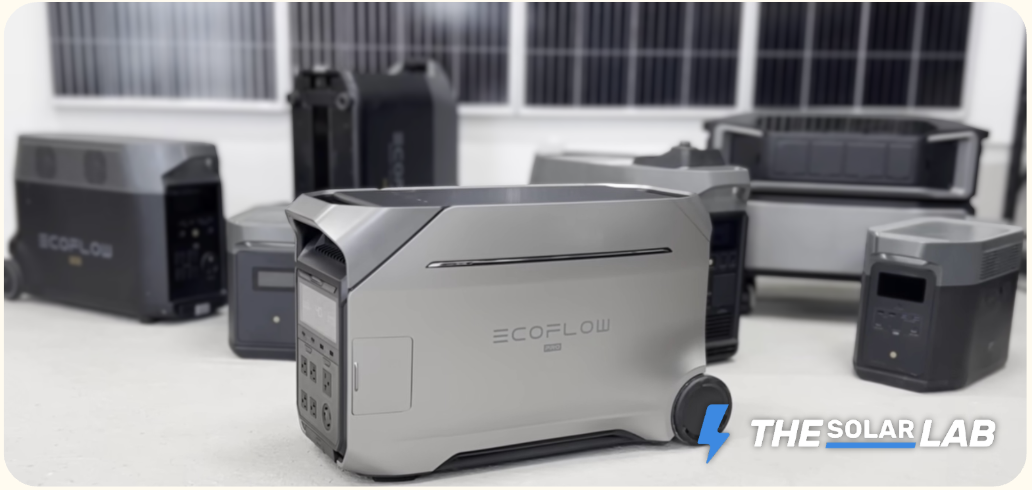
The DELTA Pro series is the top-tier EcoFlow solar generator lineup. These are the units designed to deliver serious power, making them ideal for whole-home backup and other heavy-duty applications.
Every model in this lineup offers a 240V output, high-capacity battery, powerful inverter, and compatibility with a huge ecosystem of EcoFlow accessories.
Here's how the EcoFlow DELTA Pro power station lineup shakes down:
As you move up this lineup, you get more power, more capacity, more expandability, and a higher price tag. Simple, logical, and weirdly refreshing.
For most people, the EcoFlow DELTA Pro 3 is the sweet spot. It offers excellent value, can be moved easily thanks to wheels and a suitcase-style handle, and allows you to expand battery capacity over time. Most of this can be said for the original DELTA Pro, but EcoFlow upgraded almost everything for the DELTA Pro 3.
It’s a flexible power station that covers everything from home backup to portable power for off-grid properties, RV trips, and job sites. That said, if you’re on a tight budget, the original DELTA Pro has really come down in price since it was first released, so it could still be an option for some.
The EcoFlow DELTA Pro Ultra and newer EcoFlow DELTA Ultra X are a different story. These are designed for more permanent, whole-home backup solutions. They shine when paired with multiple batteries and usually installed as a set-it-and-forget-it system. If you need a lot of power, but portability matters to you at all, the DELTA Pro or DELTA Pro 3 are the better options.
Below the DELTA Pro lineup sits the EcoFlow DELTA series, which is where most of EcoFlow’s products live, and where most of the confusion begins.
These are 120V EcoFlow portable power stations with mid-sized batteries and inverters. You would assume that this lineup should be straightforward, but it’s far from it.
Originally, things were simple. You had the EcoFlow DELTA, the DELTA 2, and the DELTA 2 Max. And honestly, the DELTA 2 Max is still one of our favorite EcoFlow power stations today.
Despite being older, it offers excellent value with a large battery, strong inverter, fast solar charging, two expansion battery ports, six grounded AC outlets, and plenty of USB options. It’s great for basic home backup, camping trips, and as newer DELTA 3 units have come out, its price has become even more attractive.
Speaking of the DELTA 3 lineup, that’s where everything has gone a bit sideways.
The links will take you to our reviews of the DELTA 3 power stations we’ve got our hands on, but we haven't even had a chance to test them all. Here’s what is included in the DELTA 3 lineup so far:
That’s not a logical product lineup, it’s just chaos.
In our opinion, EcoFlow should have split these into three distinct categories, because that’s effectively what they already are.
The DELTA 3 Ultra and DELTA 3 Ultra Plus look and feel like smaller versions of the DELTA Pro units. They have wheels, a suitcase handle, and a more premium build, but they only offer a 120V output instead of a split phase 120V/240V output.
Between the two, the DELTA 3 Ultra Plus is the clear winner. It has better features, stronger performance, and more functionality. The only reason to choose the standard DELTA 3 Ultra would be the cheaper price tag. However, if you can afford the DELTA 3 Ultra Plus power station, it’s worth it.
This includes the DELTA 3, DELTA 3 Plus, DELTA 3 Max, and DELTA 3 Max Plus. These are more traditional box-style power stations without wheels or an extendable suitcase handle.
If you’re shopping in this category, our advice is simple: just buy the DELTA 3 Max Plus. It has the biggest inverter, the largest battery, the most app features, and supports expansion batteries. Just like with the DELTA 3 Ultra series, the top-end model offers the best value.
Dropping down only makes sense if your budget absolutely requires it. In that case, we’d probably recommend taking a serious look at the older DELTA 2 Max. Again, you’d assume any DELTA 3 model would be better than a DELTA 2 power station, but that’s just not the case with EcoFlow’s ridiculous branding scheme.
Many of the smaller EcoFlow DELTA 3 models exist primarily to get people into portable power at a lower price point, but most of the real capability lives at the top of the lineup (also at the DELTA 2 Max level for some bizarre reason).
To make things even more confusing, there’s the new EcoFlow DELTA 3 1000 Air power stations. Why this is labeled a DELTA 3 is anyone’s guess. They’re more minimalist, UPS-focused power stations with fewer ports and fewer features than anything else in the DELTA lineup. It’s clear EcoFlow intended to go in a new direction with these units, but they stuck with the same naming scheme.
EcoFlow has released the EcoFlow DELTA 3 1000 Air, the DELTA 3 1000 Air (10ms UPS), and the DELTA 3 2000 Air. Three new units with really similar and confusing names… just what we needed. All three are lightweight, work with the EcoFlow app, and are designed primarily as basic units for UPS purposes, like backing up a small home office.
Here’s a quick breakdown of the three EcoFlow Air units they’ve released so far:
Honestly, if you’re choosing between any of these DELTA 3 models, our general recommendation still stands: aim for the DELTA 3 Ultra Plus or DELTA 3 Max Plus, depending on which style you want. If they’re outside of your budget, step down to the DELTA 2 Max, as it’s still a great unit.
The EcoFlow River lineup was designed for maximum portability, as well as entry-level pricing. We’ve reviewed quite a few of them, and they’ve been pretty decent (for the most part).
Here’s how the EcoFlow River power stations break down:
Yeah, it’s another mess, but these were designed to be small, compact EcoFlow portable power stations with limited output power and a small battery capacity. While they technically work, they’re tough to recommend from a value perspective.
For example, the EcoFlow River 3 Plus offers a 286Wh battery and a 600W inverter. Meanwhile, the DELTA 2 power station gives you a 1,024Wh battery and a 1,800W inverter for roughly $100 more (with our discount code). That’s three times the battery storage and three times the output power for a relatively small price jump.
If you’re already spending close to $300, it makes far more sense to step up to a DELTA unit, or even look at a Pecron power station, which will also offer far more value.
That said, if you really want to buy something from the River series, either as a gift or as a small power station for camping, the River 3 Plus Wireless Edition stands out. It’s expandable, has a decent port selection, includes removable and wireless battery banks, and even has a built-in light. Still, we just find it hard to justify when some of the DELTA models are only slightly more expensive.
Finally, EcoFlow has the TRAIL lineup, which includes the TRAIL 200 and TRAIL 300. These aren’t really power stations, they’re pretty much just large battery banks.
There are no AC outlets here, only USB ports. The TRAIL 300 does include a 12V car socket and supports solar charging, which makes it at least somewhat useful for camping or charging portable devices on the go. The TRAIL 200 does not, and is essentially just a very large phone charger.
If you’re choosing between the two, the EcoFlow TRAIL 300 DC is the only one we’d recommend.
If you want the short version:
For the most part, EcoFlow makes some really good products, but their naming and product structure make buying one a lot harder than it needs to be. Hopefully, this breakdown saves you time, frustration, and money.
If you’re still feeling confused about what you need, you can always take our Power Station Quiz. After answering a few quick questions, we’ll recommend a power station that would work for your needs.

We test solar products so you don’t have to. Check out our opinions and which units we think are worth your money and which ones aren't.
More Reviews >