When most people think of solar power systems, they picture solar panels soaking up sunlight, batteries storing that power, and, if they have any experience with residential solar, they might even think about a solar power inverter.
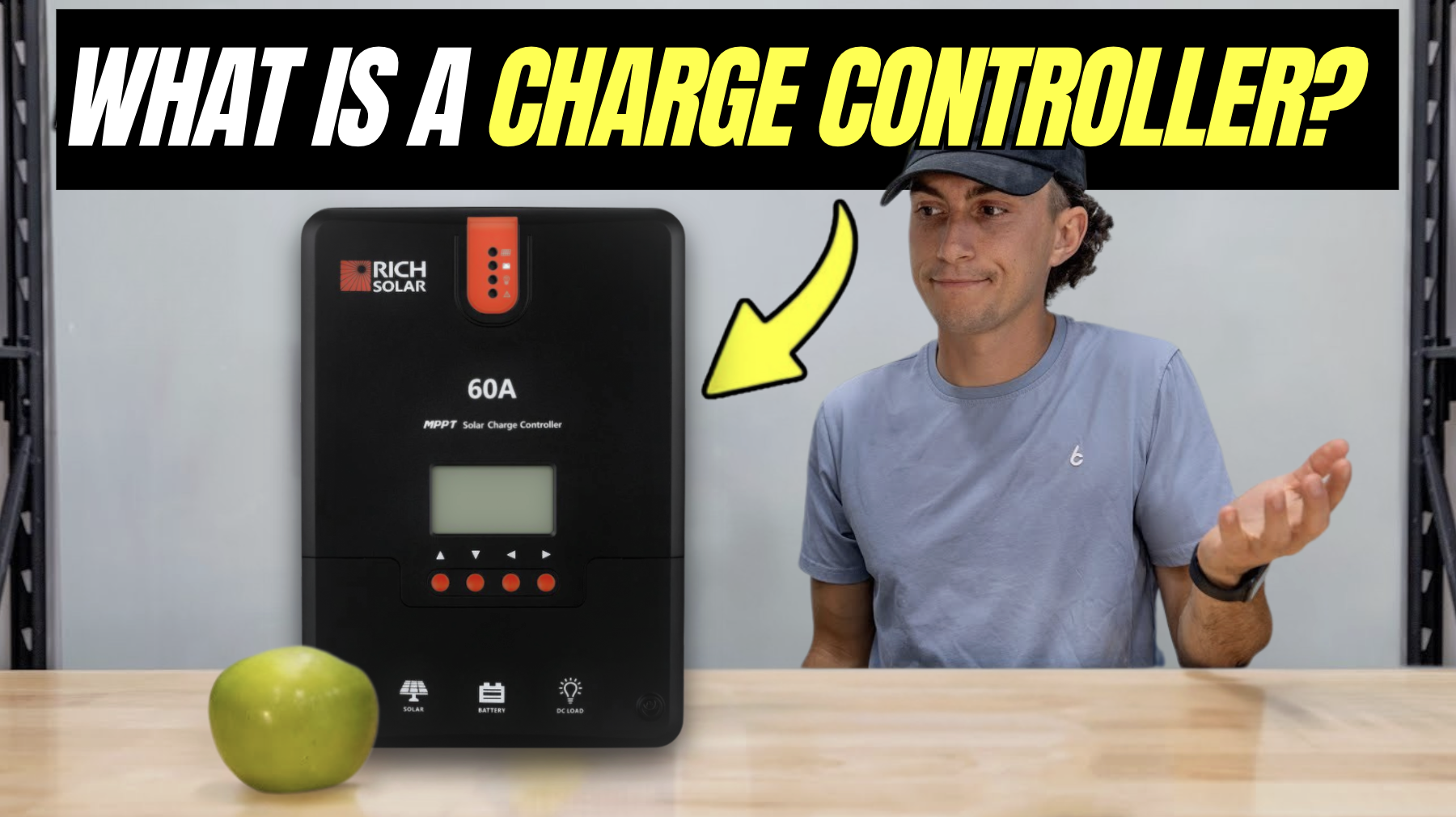
What almost never gets any love is the unsung hero of any solar power system, the solar charge controller.
This little piece of equipment ensures that solar energy flows smoothly from your panels to your battery bank, without overcharging them, wasting power, or having the batteries drain overnight. You can almost think of it like the “traffic cop” for your system.
To help you get a lock on what the charge controller of a solar panel system is, we’re going to explain what they do, how MPPT and PWM controllers compare, and how they fit in with your inverter and other solar components.
Put simply, a solar charge controller regulates the voltage and current coming from your solar panels before that power is fed into your batteries.
The main job is to make sure that your batteries are charged efficiently, safely, and consistently.
Without an appropriately sized charge controller, your batteries might get overcharged, which can result in them wearing out and degrading faster. Charge controllers also prevent reverse current flow at night, protecting your solar panels from draining your batteries.
Without a charge controller, power stored in your batteries could flow back to your solar panels, which would do absolutely nothing for you.
Here’s what your charge controller does for you every single day your solar power system is running:
Now, when it comes to solar charge controllers, you’ll come across two major types: MPPT and PWM. Here’s a quick breakdown:
An MPPT solar charge controller is pretty much the gold standard these days for any type of decently sized solar power system. They are also the more high-tech and efficient option.
Essentially, MPPT controllers constantly monitor the output of your solar panels and adjust the voltage to extract the maximum possible power. This means you can get more juice out of your panels, especially in less-than-ideal conditions, like during cloudy days or during the winter months.
Put simply, a charge controller with MPPT is a smarter, more efficient option that helps squeeze every watt of power from your solar panels.
A charge controller PWM is basically a simpler and cheaper option than an MPPT controller. While they’re now seen as a bit dated, this also means they are usually a more cost-effective option, and they can still work for certain solar setups.
A PWM controller works by rapidly switching the connection between the panels and the battery on and off, which effectively maintains a steady charging voltage. While they’re not as efficient as MPPT controllers, they’re perfectly adequate for smaller systems and they are generally much less expensive.
The main takeaway is the fact that larger and more sophisticated systems use MPPT charge controllers, as you want to protect your expensive batteries and squeeze every bit of power from your panels. They don’t convert excess voltage into usable current like you get with an MPPT controller, so they’re less efficient.
For basic setups, a PWM controller that you just plug directly into your batteries can do the trick while also saving you a few bucks.
Basically, they’re not bad, they’re just a bit old-school and not quite sophisticated enough for most modern solar power systems.
Sizing your solar charge controller correctly is extremely important if you want to ensure that your system runs smoothly and efficiently. Here’s what you need to consider:
Look at the maximum current output from your solar panels. Your charge controller should be rated to handle at least that amount, ideally with a little extra headroom. For example, if your panels output 20 amps at peak performance, a 30A charge controller would be a safe bet.
Make sure the controller matches your battery bank’s voltage. Common battery systems are 12V, 24V, or 48V. Using a charge controller designed for a different voltage can lead to inefficiency or even damage your batteries over time.
If you plan on adding more panels or batteries in the future, opt for a charge controller with a higher rating than you currently need. This way, your system can grow without you needing to completely overhaul and replace components. Oversizing your charge controller is going to be less expensive than having to completely replace it in the future.
Now, we’re going to get a little bit more technical here, so if you’re not interested in how a charge controller works, and only really care about what they do, feel free to skip this section. Still, it might be interesting if you’re the type of person who wants to know how your solar power system is actually delivering you all of that free electricity.
Here’s how charge controllers (both MPPT and PWM) perform their main functions:
The charge controller continuously samples both the voltage and current output from your solar panels. It’s constantly checking the battery’s state of charge and comparing it to the ideal charging parameters.
This real-time monitoring is crucial for preventing overcharging and for ensuring that the battery receives the right amount of power at any given time.
Inside an MPPT charge controller, an algorithm continuously calculates the Maximum Power Point (MPP) of your solar panels, which is the unique combination of voltage and current where the panels produce the maximum wattage. Solar panels have a characteristic curve, and the MPP can shift with temperature, sunlight intensity, and other conditions.
On the other hand, PWM controllers take a simpler approach. They rapidly switch the connection between the solar panels and the battery on and off. The ratio of the “on” time to the “off” time (known as the duty cycle) is adjusted so that the effective voltage delivered to the battery stays within a safe range
This “chopping” action maintains the battery at a near-optimal charging voltage by averaging out the voltage over time. It’s way less sophisticated (and efficient), but this is also why PWM controllers are so much cheaper.
In addition to optimizing the charging process, the charge controller also prevents reverse current flow. Without this feature, the battery could discharge back into the solar panels at night or during low light conditions.
A diode or similar mechanism is used to block this reverse flow, protecting the power you have stored in your batteries.
Some advanced charge controllers can also manage the power to connected loads (devices powered directly from the battery).
This means they can prioritize charging the battery over powering a load, or vice versa, depending on your system’s design and your energy needs. You see this a lot with more sophisticated power inverters that have built-in charge controllers, like the EG4 18kPV Hybrid Inverter.
In many systems, the charge controller and inverter are separate devices. The charge controller manages battery charging, while the inverter converts DC battery power into usable AC electricity.
In newer systems, you’ll often see a charge controller with inverter built into one unit, especially with higher output hybrid inverters from the top brands, like EG4 and Rich Solar. These all-in-one systems simplify wiring, improve efficiency, and make system monitoring easier.
If you’re looking at buying a portable power station and some solar panels, you don’t have to worry about a charge controller at all. Any power station that has a solar input will have a built-in charge controller, with most of the higher end units including an MPPT controller.
A solar charge controller might not be the flashiest component in your solar system, but it’s absolutely essential.
Think of it like a guardian that ensures power stays in your batteries overnight, and that your batteries are charged safely, efficiently, and without any nasty surprises.
Signature Solar Deals: https://signaturesolar.com/charge-controllers...
Use Code: SOLARLABGET50 for $50 Off Your Order
Shop Solar Deals: https://shopsolarkits.com/charge-controller...
Use Code: THELAB for 4% Off Your Order
Explore more practical tips, guides, and insights to help you get the most out of solar
More Resources >