Watts are one of those numbers you see everywhere, including on light bulbs, kitchen appliances, solar panels, and portable power stations, but few people actually know what these numbers mean. And yet, watts are one of the most important concepts to understand if you’re working with electricity, solar power, or battery backup systems.
Normally, we review products, but today we want to help you understand one of the most important units for sizing any type of power station, inverter, battery bank, and even solar panels. We want to do this not just because it’s useful to know, but because knowing what you actually need can help save you money (and avoid being ripped off). Let’s jump into it.
Let’s start with the basics. Watts are a unit of power. It’s a measure of how much electrical power something is using at a specific moment in time. Without watts, it would be really difficult to compare electrical devices and appliances. You wouldn’t know how much power a toaster used compared to a laptop, or whether a portable power station could handle running a microwave.
The term “watt” comes from James Watt, an 18th-century Scottish inventor and mechanical engineer best known for improving the steam engine. He didn’t discover electricity, but his work helped define how we measure power.
Later, the watt was named in his honor as a standardized unit of power. Today, it’s a unit that we use to measure how much work energy can do at a given time. So, when people talk about watts meaning in electricity, they’re talking about how much power is being consumed or produced right now.
One of the biggest sources of confusion in electricity is the relationship between watts and other electrical terms, like volts and amps. You’ll often hear people mention “watts and amps” interchangeably, but they aren’t the same thing.
Here’s a simple way we like to think of it:
If you know your volts and amps, you can also calculate watts using this simple formula:
Watts = Volts × Amps
So, if a device runs on 120 volts (the standard household power you’ll pull from an outlet in North America) and pulls 2 amps, it’s using 240 watts of power (120V × 2A = 240W).
We’ve used this analogy quite a few times in our educational videos, but you can almost think of these electrical measurements like water flowing from a hose.
Voltage is like water pressure. Amperage is like the size of the hose, meaning how much water can flow through it at any given time. Watts are how much water actually comes out the end.
A small garden hose with low pressure doesn’t move much water. A fire hose with high pressure and high volume moves a lot of water. It’s a pretty simplified version of what’s going on, but it’s a good way to visualize electricity.
Whenever you want to know how much power something is using at a specific moment, you look at watts. For example, a laptop charger might be rated at 60 watts, meaning it requires 60 watts to run. On the other hand, something like a mini fridge might use 120 watts while running, and a microwave could easily pull 1,000 watts or more.
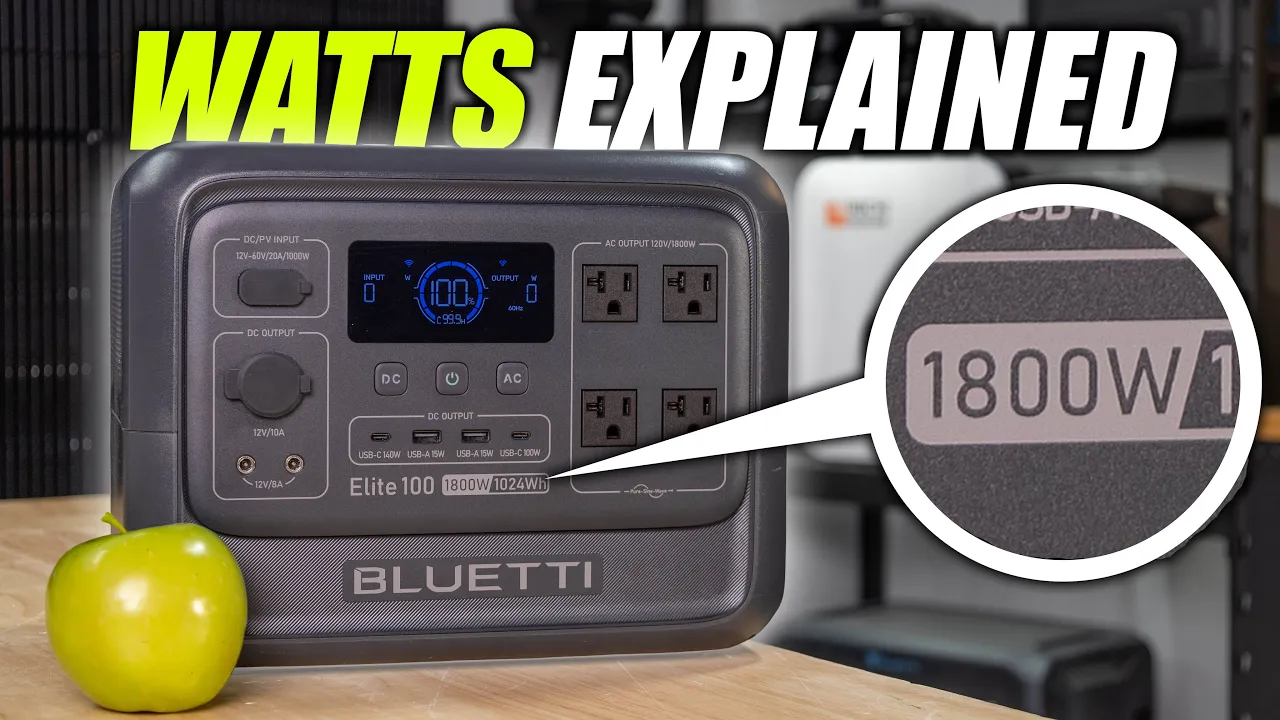
This information isn’t just important for curiosity’s sake, it’s critical when choosing a power station. Whether you’re looking at something like an EcoFlow DELTA Pro 3 with a 4,000W inverter or a tiny Anker SOLIX C300X with a 300W inverter, that output rating tells you how many watts the unit can supply at a given time.
If your appliance needs more watts than the inverter can deliver, or you’re trying to run multiple devices that have a total wattage that exceeds the inverter’s output rating, the power station will not be able to supply it. Some will automatically shut off, while others can surge a bit beyond their rated inverter output.
This information is also important for answering one of the most common questions we see: how many watts do refrigerators use? Most modern refrigerators pull between 100 and 200 watts while running, but they can surge much higher when the compressor starts. When we ran a few tests, we calculated that a fridge will use around 1,300Wh per day.
So, this means you’d need a power station that could deliver at least 200W from its inverter, and it would require at least a 1,300Wh battery capacity just to keep the fridge running for a day.
Understanding that wattage helps you avoid under-sizing your power station, as well as components for a more traditional solar power system.
Let’s put this into a real-world example. Say you’re setting up a power station for a small property, like Dylan did for his own off grid tiny home. The first thing you need to know is your running watts, which is the total amount of power that will be used at any given moment.
Imagine you want to run the following electrical loads at the same time:
Add those together, and your total power draw is 270 watts. That number tells you how big of an inverter you need. Any power station you choose must be able to supply at least that many watts at the same time.
Basically, Watts measure power, while Watt-hours measure energy over time.
To make sure you can always meet your power requirements, plus have a little extra wiggle room for unexpected loads, like plugging in a phone, we recommend choosing an inverter with a higher output rating than you think you need. In this case, we’d probably say choose something with a 300W inverter as a minimum, rather than just trying to hit that 270W number.
This is where things often get confusing, even for people who’ve been around solar for a while (like us). Watts (W) and watt-hours (Wh) are related, but they are not the same thing.
Think of it like driving a car. Your speed (miles per hour) tells you how fast you’re going right now. Distance (miles) tells you the distance you’ve traveled over time. Think of Watts like your speed, and Watt-hours like your total distance.
If a lamp uses 50 watts, that means it’s consuming power at a rate of 50 watts right now. If it runs for one hour, it uses 50 watt-hours of energy. Run it for two hours, and the watt hours would double to 100Wh. Run it for 30 minutes, and it uses 25 watt-hours.
This difference matters a lot when you’re dealing with solar batteries and power stations.
Now let’s bring it all together. Say you have a portable power station with just over a 1,000Wh battery, like an EcoFlow DELTA 3 Plus, and your setup is drawing 270 watts continuously. To estimate runtime, you divide the battery capacity by the power draw:
1,024Wh ÷ 270W = 3.8 hours
That means you’ll get about 3 hours and 48 minutes of runtime before the battery is depleted (not accounting for efficiency losses through idle consumption). This is why understanding watts, watt-hours, and total power consumption is so important when choosing a power station.
This exact math applies whether you’re using a small unit like the Bluetti Elite 100 V2 to charge a few portable electronics, or a larger system like the EcoFlow DELTA Pro Ultra for whole home backup.
If there’s one takeaway from all of this, it’s that watts help you avoid overspending or buying the wrong pieces of equipment.
When you understand watts, you can properly size your inverter. When you understand watt-hours, you can estimate runtime accurately instead of guessing, and size your power station or battery bank.
The next time you’re looking at solar gear or a portable power station, don’t just look at the marketing. Ask yourself:
Just being able to answer those questions will put you way ahead of most buyers.
If you’re unsure how much power your household appliances and devices require, we have a handy Power Consumption Calculator. It’s super easy to use and should help you calculate your own power usage.
Understanding watts doesn’t make you an electrician—but it does make you a smarter power user.
If this guide helped clear things up, check out some of our power station reviews or beginner solar guides. If you need help choosing the right power station for your needs, you can also take our quick Power Station Quiz, which will match you with an appropriate and high-quality unit.
If you’re still feeling confused about the components you need for a traditional solar power system, we have a few guides that could help:
Signature Solar: https://signaturesolar.com/solar-kits...
Use Code: SOLARLABGET50 for $50 Off Your Order
Shop Solar: https://shopsolarkits.com/solar-power-systems...
Use Code: THELAB for 4% Off Your Order
Explore more practical tips, guides, and insights to help you get the most out of solar
More Resources >