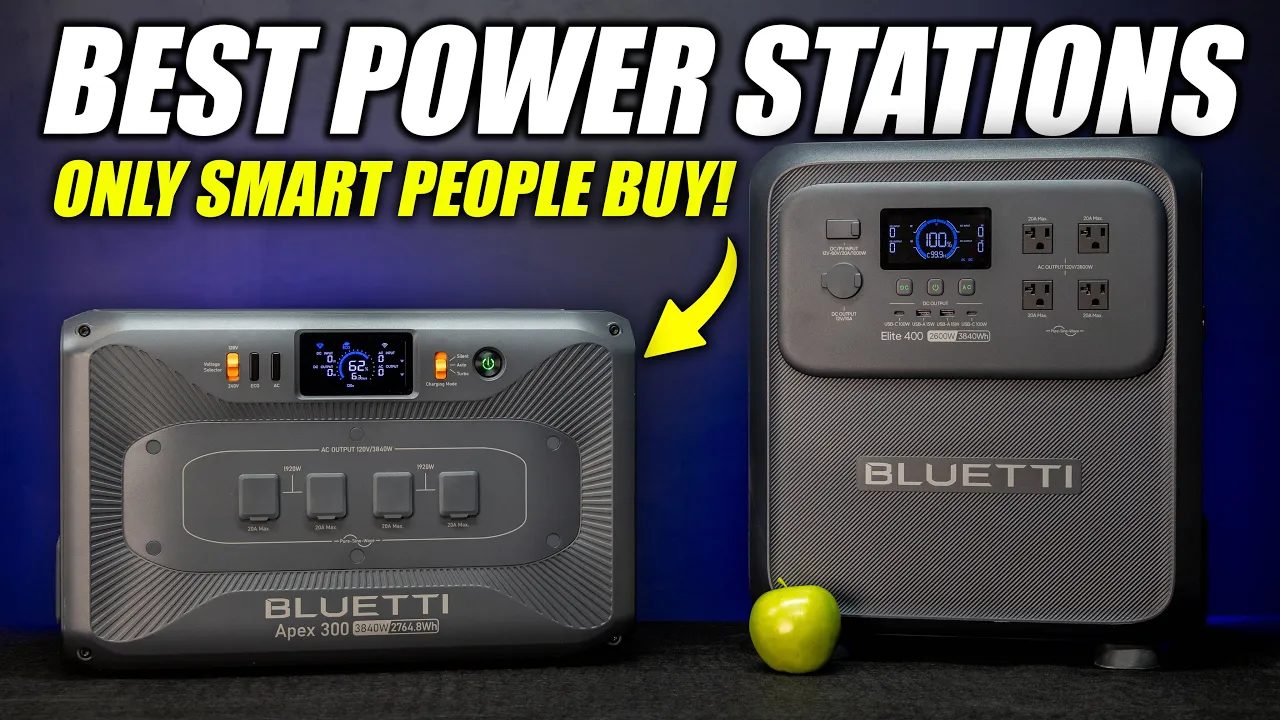
Bluetti released two very different power stations in 2025: the Bluetti Apex 300 and the Bluetti Elite 400. What makes these units interesting isn’t that they try to out-spec every competitor on the market, it’s that they intentionally don’t.
Where most power station brands are releasing numbers with bigger numbers, more ports, and more complex features, it seems a different approach was taken with these two Bluetti portable power stations. Both units do less on purpose, and because of that, each one ends up being better suited for a very specific type of user.
They’re also priced almost identically, so if you’re trying to decide between these two Bluetti solar generators, things can get a bit confusing. To help you make the right choice, we’re going to compare them side-by-side, cover their strengths and weaknesses, and explain who should buy each power station.
Before we get into the nitty-gritty of this Bluetti buyer’s guide, here’s a quick overview of how the two power stations compare to each other on paper:
While the units look somewhat similar at first glance, the on-paper specifications don’t tell the full story. To help you make the right choice, we’re going to see how they stack up against each other across a few key points.
If you would like a more in-depth breakdown for either power station, we also have individual reviews you can watch and read:
For now, let’s see how these two Bluetti power stations stack up against each other one-on-one:
One important update worth mentioning upfront: at the time of writing, both the Bluetti Apex 300 and Bluetti Elite 400 are now available in the US and Canada. When they first launched, availability was limited for both power stations, and it was pretty much impossible to order either in Canada. That no longer seems to be the case.
Pricing is actually one of the main reasons why we wanted to put together this buyer’s guide, as Bluetti priced them both right around $1,400 USD. Normally, price can be a major deciding factor between two power stations, especially for those with tighter budgets.
With the Bluetti 300 and Bluetti Elite 400, the decision is less about cost and more about how you plan to use your power station.
The easiest way to understand these two units is to look at how different their core specifications are.
As you can see from the specifications table above, the Bluetti Apex 300 Power Station features a 2,764Wh battery that is paired with a 3,840W inverter. Since it can also support 240V outputs, it is capable of running more demanding appliances.
You also have the option to expand the main unit’s storage capacity by pairing it with up to 20 of Bluetti’s 2,764Wh B300K Expansion Batteries. With the fact it also supports up to 4,000W of solar input if you purchase the SolarX 4K Adaptor, you’re talking about a unit that could easily be used for home backup applications.
On the other hand, the more modest Bluetti Elite 400 Power Station flips that formula completely. It has a 3,840Wh battery, which is significantly larger than the Apex, but it pairs that battery with a smaller 2,600W inverter.
And, while it does have a higher capacity battery than a single Bluetti Apex 300, the Elite 400 does not support expansion batteries. It’s also limited to a 120V output, with a maximum solar input of 1,000W.
Same price, but designed for completely different priorities and use cases.
Neither of these Bluetti portable power stations is overloaded with ports, and that’s intentional.
The Apex 300 keeps things extremely minimal. You get four standard 120V AC outlets on the front, along with multiple 240V outlet options on the side. These 240V ports are primarily designed for use with a transfer switch, making the Apex 300 well-suited for home backup or semi-permanent installations.
In a unique twist, the USB ports and 12V outputs are not built into the Apex 300 unit. If you decide that you need those plugs, Bluetti sells an optional adapter. This helps simplify the unit, as well as keeping the cost down.
Bluetti must have realized that most people looking for a home backup power station aren’t going to car as much about charging smaller devices, like phones and laptops, directly from the unit. You’d still have the option to plug your phone charger into any of the 120V plugs, but you can’t do a direct USB charge without that adaptor.
The Bluetti Elite 400 feels more like what we’ve come to expect from a portable power station. It also includes four 120V AC outlets, but you get two USB-A ports, two USB-C ports, and a 12V car socket built into the front panel.
The Elite 400 was also clearly designed to be moved around. It features rugged wheels and one of the best suitcase-style handles we’ve seen on any power station. If you’re just looking for something that can be used for everyday scenarios, you get a lot of battery capacity and a reasonably high inverter output in a very user-friendly and portable unit.
Both units work well with the same version of the Bluetti app, and both have the same display screen, allowing you to control most of the basic functions right from the unit itself.
If you need 240V power, the decision is simple: the Bluetti Apex 300 is the clear winner.
This Bluetti power station is best suited for people who want a set-it-and-forget-it solution. It’s an excellent option for a backup power system you want to leave in the garage, a utility room, a backyard shed, or any sort of off-grid setup where the unit won’t be moved often.
It can power 240V appliances, including some of the most demanding, like dryers, ovens, and certain power tools. That 240V port can also integrate cleanly with a transfer switch for light home backup.
One great real-world example from our testing involved installing the Apex 300 in Mr. Health and Safety’s tiny home, where it was used to run power tools during an expansion project. It was used for an extended period with minimal fuss, and that’s exactly the kind of use case this unit is built for.
While the battery capacity may sound modest at first, the Apex 300 was designed to be scaled up. With expansion batteries and multiple units, you can build a system with serious capacity and output.
In fact, Bluetti currently offers bundles that deliver over 11kWh of storage and more than 7,000W of inverter output, putting it in direct competition with systems like the EcoFlow DELTA Pro Ultra, but at a lower price point (about $600 less).
If you’re looking for a reliable power station that can be used for light home backup, a basic off grid system, or any other application where you’d want high power output and expandability without unnecessary extras, the Bluetti Apex 300 could be the ideal option.
If you want a large battery in a single, portable package, the Bluetti Elite 400 is hard to beat.
It’s a bit of a weird design when you consider the fact that most power stations have an inverter output that closely mimics the battery capacity, but we think the battery-to-inverter ratio is actually really smart (for certain types of people).
On the surface, it’s clearly built for users who only need 120V power, but want extended runtime without dealing with expansion batteries.
Traditionally, getting a battery this large would also mean paying a premium for a much bigger inverter than you actually need.
For example, the DELTA Pro 3 has a 4,096Wh battery, which is similar to the Elite 400’s 3,840Wh battery, but the EcoFlow power station has a 4,000W inverter.
Since the Elite 400 only has a relatively modest 2,600W output, Bluetti are able to price it $400 cheaper than the DELTA Pro 3.
Basically, by pairing a moderate inverter with a large internal battery, Bluetti is able to keep manufacturing costs down, which they then pass on to the buyer.
The end result of this design is an all-in-one unit that’s easy to move, easy to use, extremely practical, and reasonably priced. As mentioned, the suitcase-style handle and built-in wheels are some of the best we’ve tested over the past year. Everything about it just feels solid.
A unit like this would shine for really basic emergency backup situations, like situations where the power goes out and you want to wheel it around your house to run a fridge, lights, or some other small appliances for a few hours or a single day. It’s also a great choice for camping, tailgating, or throwing in the back of a truck or trailer for power on the go.
If portability and simplicity matter more to you than raw output or expandability, the Elite 400 is probably going to be the better Bluetti solar generator for your needs.
There’s no universal winner in this comparison, and that’s a good thing. Since there really isn’t a noticeable price difference between them, you basically just have to ask yourself which unit would be more practical for your specific needs.
After putting both units through a huge variety of real-world tests, we’d say you should choose the Bluetti Apex 300 if you want high inverter output, 240V capability, future-proof expandability, and a more permanent home or off-grid setup.
On the other hand, you should choose the Bluetti Elite 400 if you want a portable, all-in-one Bluetti power station with a large battery, excellent mobility, and simple 120V outputs.
If you’re still not sure which Bluetti portable power station is right for you, we recommend taking our Power Station Quiz, which will provide a personalized recommendation based on how you actually plan to use your power.

We test solar products so you don’t have to. Check out our opinions and which units we think are worth your money and which ones aren't.
More Reviews >