When the winter storms rolled through the U.S. and Canada earlier this year, a lot of people were reminded of something we say all the time at The Solar Lab: Your power can disappear fast. It’s only a disaster if you’re not prepared.
When we’re talking about being prepared for outages, we’re not talking about running your entire house like nothing happened. If you want to power a central AC, electric furnace, your convection oven, and everything else in your home, you’re going to need to look at a much larger, permanent backup power system.
This guide is about keeping the essentials running, meaning your fridge, Wi-Fi, lights, phone charger, and maybe a CPAP. The point here is running your basics, so you can ride out an outage safely and comfortably.
To walk through a realistic setup, and how you’d use it, we’re going to use the Bluetti Apex 300 as an example power station. While we’ll be using this Bluetti power station throughout this guide, the same principles could be applied to pretty much any reliable portable power station out there.
One of the main reasons for the surge in demand for portable power stations is for the simple fact that they’re practical sources of power during outages. Unlike traditional solar power systems, portable power stations are all-in-one systems that are designed for plug-and-play use.
They’re also relatively affordable when compared to traditional backup power systems, which require multiple components that must be fixed in place.
But how do you choose the right portable power station for an outage, and how do you actually use it correctly once you have one? Well, you could just follow a couple of straightforward steps.
A lot of people ask the wrong questions when they’re first getting into solar and backup power. This can have you looking for specifications and units that aren’t actually relevant to your real-world needs.
When you’re talking about power stations you can use for basic backup, the wrong question is: “How many watts does a power station have?”
Instead, the right question you should be asking is: “How long will it run the things I actually care about?”
There are two specifications that actually matter when you’re talking about backup power for an outage:
This refers to the most power the unit’s inverter is capable of outputting at any given time. Measured in watts (W), output wattage is the number that will let you know what types of appliances and devices your unit can actually handle.
In other words, what can a particular power station handle running at the same time? Can it start your fridge, run your CPAP, and even do all of that at the same time?
This is a simple measure of the size of a power station’s battery. It’s measured in watt-hours (Wh) or kilowatt-hours (kWh).
Basically, battery capacity lets you know how long a power station is able to supply power to your loads during an outage. Can it only run for a couple of hours, or can it get you through a multi-day outage.
A lot of people get excited by units with big inverters that have a high output wattage number. So, they go out and buy a unit with huge wattage, and then realize the battery doesn’t last nearly as long as they expected.
When you’re talking about running a power station for backup power, there’s also a hidden factor: idle consumption.
How much stored battery power a portable power station uses while it is sitting idle is probably the factor that most people overlook when shopping for a portable power station.
The truth is, some units burn a surprising amount of power whenever they’re turned on, even if you aren’t actually pulling any power from them to run your loads.
We’ve tested models that draw 70W to 80W per hour doing nothing. Some of these are even high-quality power stations from reputable brands, like the Anker SOLIX F3800, so it’s something you should always pay attention to if you’re going to be relying on your power station for backup power.
Idle consumption can eat through your battery faster than you think, especially if you have to keep your unit on for multiple days at a time. Helping you avoid these inefficient power stations is actually one of the main reasons we test and review so many different units.
During a power outage or emergency situation, you’re not going to be running everything in your home like it was any other day of the week. Instead, you’re going to conserve power and prioritize the essential loads you actually need.
Here’s what a practical emergency setup might look like:
Based on our own power calculations, running these loads would put you around 2,220Wh per day. Sure, your exact needs may vary, and some people won’t need to run power hungry medical equipment, like a CPAP, but roughly 2,200Wh per day is a realistic amount of power for the average household’s emergency needs.
We’re intentionally leaving out heating and air conditioning because that’s highly situational. Running a mini-split unit during an outage is one thing, but the large central AC units needed to deal with Texas heat will drain batteries extremely fast.
Want to run an electric furnace with a power station? Don’t even try it. On the other hand, a gas furnace is far more manageable, as you’re only really pulling power for the fan.
The key takeaway here is to plan your system for where you live and what you need to power during an outage. Unless you really want to oversize your power station so you can kick back and play video games and run other unnecessary loads, you should be able to get away with a fairly modest power station setup.
We’re going to be looking at the Bluetti Apex 300 as an example power station for backup power during an outage.
This Bluetti unit stands out to us for this purpose because it doesn’t try to be something it’s not. It’s a purpose-built unit for basic backup power that keeps things simple.
Here’s what you get with the Bluetti Apex 300:
On top of all of that, the Apex 300 has a low idle consumption of about 20W per hour, which is excellent for a 240V-capable unit. As mentioned above, a lot of the 240V power stations we have tested in the past idle closer to 80W per hour. That difference can really add up fast over a 24-hour period.
The Apex 300 is also very expandable, which means you don’t have to buy everything at once. You can start with the main unit, then scale up your battery capacity with expansion batteries as your needs and budget grow.
Some of the Bluetti portable power stations we tested in the past seemed overly complex, while this one hits a sweet spot between simplicity, power, and efficiency.
To show you how effective a portable power station can be for basic backup power, let’s run the numbers with an Apex 300 using our 2,220Wh per day example from earlier.
On its own, the Apex 300 has 2,764Wh of battery capacity. With that said, our tests revealed that it idles at about 20W per hour. Over a full 24 hours, that’s about 480Wh per day of stored battery capacity used just leaving the unit on.
Accounting for idle consumption, that leaves you with roughly 2,284Wh of usable power:
2,764Wh – 480Wh = 2,284Wh of available power
That almost perfectly covers our 2,220Wh essentials estimate.
A single Apex 300 power station can realistically handle one conservative day of running essentials. That’s assuming you’re disciplined, and not just watching TV and plugging in random devices you don’t really need.
If you don’t need to use a CPAP, you’ll have more breathing room for lights or other loads, like watching some TV, making a pot of coffee, or giving your laptop a charge.
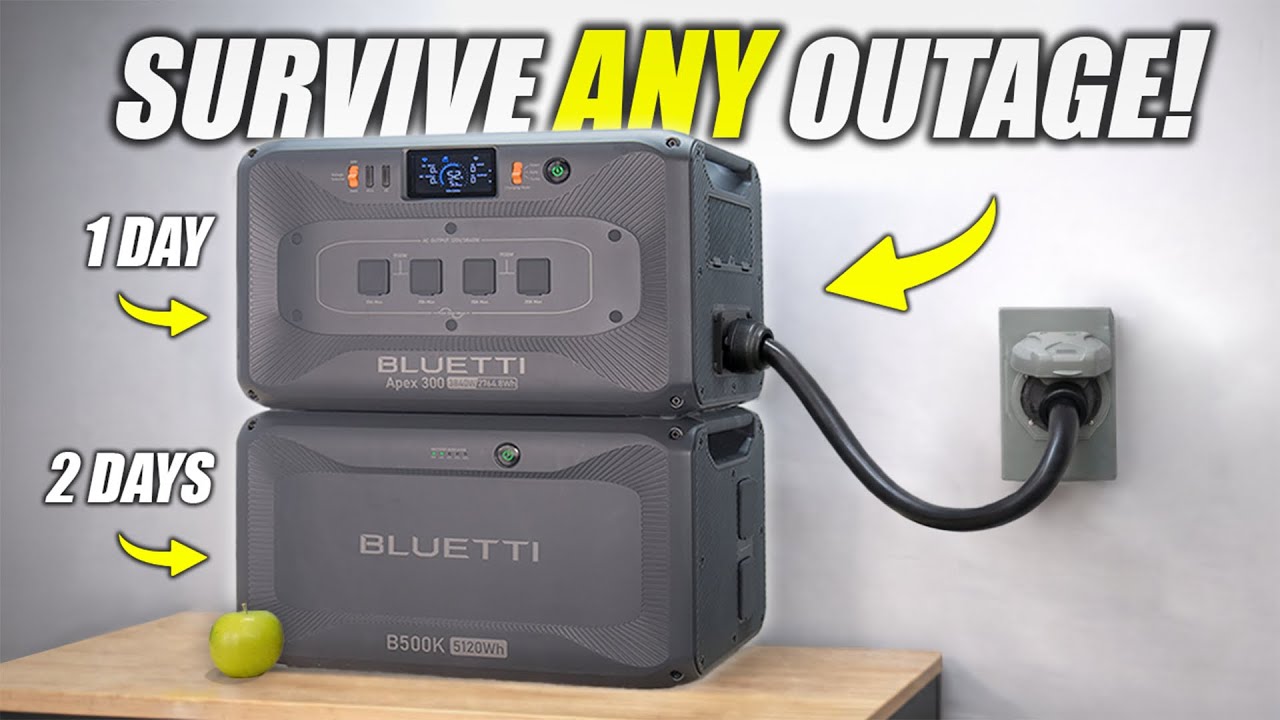
For a two-day power outage, add one Bluetti B300K Expansion Battery. This would add another 2,764Wh of storage capacity to the 2,284Wh of usable power we calculated an Apex 300 would give you. Theoretically, a single Apex 300 and one expansion battery would give you a total battery capacity of 5,048Wh, or 5kWh.
Expansion batteries don’t have any additional idle loss because only the main unit’s inverter and display screen draw idle power. That means you gain nearly the full battery capacity from each Bluetti B300 Expansion Battery that you add to your backup power setup.
Instead of stacking two B300K batteries, it usually makes more sense to add the Bluetti B500 Expansion Battery.
With the Bluetti B500 Battery, you get an additional 4,960Wh of capacity, instead of the 2,764Wh you get with the B300 battery. So, you’re getting more capacity for the price and a more simplified system.
With 7,244Wh of total storage capacity, the Apex 300 plus one B500 can comfortably cover a three-day outage under conservative usage.
Bluetti technically allows you to stack up to 20 expansion batteries onto this system, so your total battery capacity could scale to 58kWh, but for most households, 1 to 3 days of battery capacity is the practical goal.
The smartest outage plan isn’t buying and stacking a crazy number of expansion batteries. Instead, it’s having a way to recharge the batteries you already own. Here’s how you would do that:
If you live somewhere with reliable sunlight, charging with solar panels is ideal. Like most solar generators, the Apex 300 has built-in solar inputs, so you can plug your panels directly into the unit.

If you want to significantly increase the unit’s 2,400W solar input, Bluetti offers the Bluetti SolarX 4K. This plug-in accessory allows you to push the solar input up to 6,400W, which would be really useful if you’re running expansion batteries and want to charge everything with solar quickly.
With enough solar and good conditions, you could recharge an Apex 300 plus B500 system in just a few hours of strong sunlight, effectively resetting your 2 to 3-day runway.
That’s what makes this particular Bluetti solar generator setup so powerful during extended outages. That’s not to say the Apex 300 is the only unit that could be solar charged during an outage, but a 6,400W solar input really does stand out. For comparison, the EcoFlow DELTA Pro 3 packs a 2,600W solar input, which is actually really solid.
If you’re like us, meaning you live somewhere with dark winters and inconsistent sunlight, adding a small gas generator to your setup can be a very practical option.
Instead of running your gas generator 24/7 to power all of your loads, including intermittent ones, like a sump pump, you can:
As long as you have enough stored fuel, or access to a gas station, this setup can run indefinitely. Using a gas generator to charge a power station gives you a way to access off-grid power, and it’s much quieter and more practical than running a gas generator on its own.
If you’re interested in learning more about this approach, we actually put together a guide: Gas Generator vs Power Station Guide
If you want a realistic emergency setup:
You can use our Power Consumption Calculator to add up your daily energy usage. This will give you a fairly accurate measure of the watts and watt-hours you need day-to-day. This number will then allow you to choose a power station that works for you, as well as determine how many expansion batteries you need (if any).
If you don't need to power your fridge and other major appliances, you could even get away with a small power station, like an Anker SOLIX C300X or an EcoFlow River 3 Plus.
When you just need to charge your phone, run a few lights, and maybe plug in a few smaller appliances for a couple of hours, these smaller and more portable power stations can be really practical and affordable alternatives to the bigger units.
Remember, you don’t need a massive whole-home system to survive a blackout. With the right portable power station, like a Bluetti Apex 300, you can keep your food cold, your devices charged, and your household comfortable for days.
Backup power and emergency prep isn’t about spending tens of thousands of dollars on some elaborate setup. It’s about understanding your real needs, and matching them with the right tools before the lights go out.
If you need help choosing the right power station, we also offer a Power Station Quiz. It only takes a couple of minutes to fill out, but it will match you with a reliable power station that will meet your unique needs.
Check Price at Bluetti: https://www.bluettipower.com/apex-300
Use Code: THESOLARLAB5 for 5% Off at Bluetti
Check Price at Shop Solar: https://shopsolarkits.com/products/bluetti-apex-300
Explore more practical tips, guides, and insights to help you get the most out of solar
More Resources >