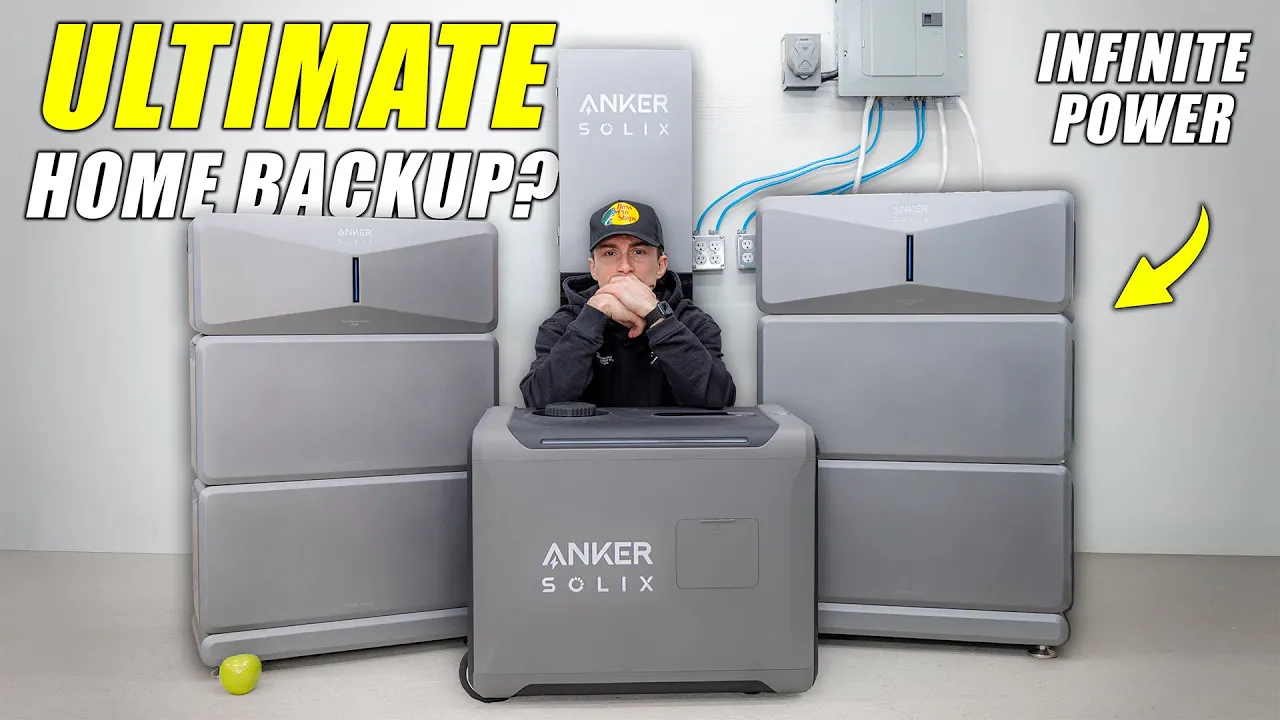
Anker SOLIX launched their E10 Whole-Home Backup System earlier this year. After getting our hands on it, it became really clear that this was designed to be Anker’s attempt to compete with other modular, home backup systems, like EcoFlow’s DELTA Pro Ultra.
With the addition of the Anker Power Dock and the Anker SOLIX Tri-Fuel Smart Generator 5500, it’s pretty clear the goal here is to create a system that can power your entire home and scale as your needs grow. It’s an ambitious goal, and something that made us want to take a look at the whole system for ourselves.
We’ve already reviewed the Anker SOLIX E10 as a standalone power station, but this time we’re looking at the full ecosystem. We want to see how it works together, where it excels, and whether it actually makes sense to spend this kind of money compared to more budget-friendly alternatives, or even a traditional solar power system.
When you purchase all of the Anker E10 components and accessories together, the system is designed to provide simplified and legitimate whole-home backup power.
Anker actually markets the entire system as an “infinite” power source, which sounds a little flowery, but it seems the thinking here is that between their tri-fuel generator and a solar panel array, the system can deliver a constant supply of off-grid power to your home.
To see how well this setup comes to actually delivering enough power for an entire house, we tested everything. You can read or watch our Anker SOLIX E10 reviews if you’re curious how the base system works, but this testing went further.
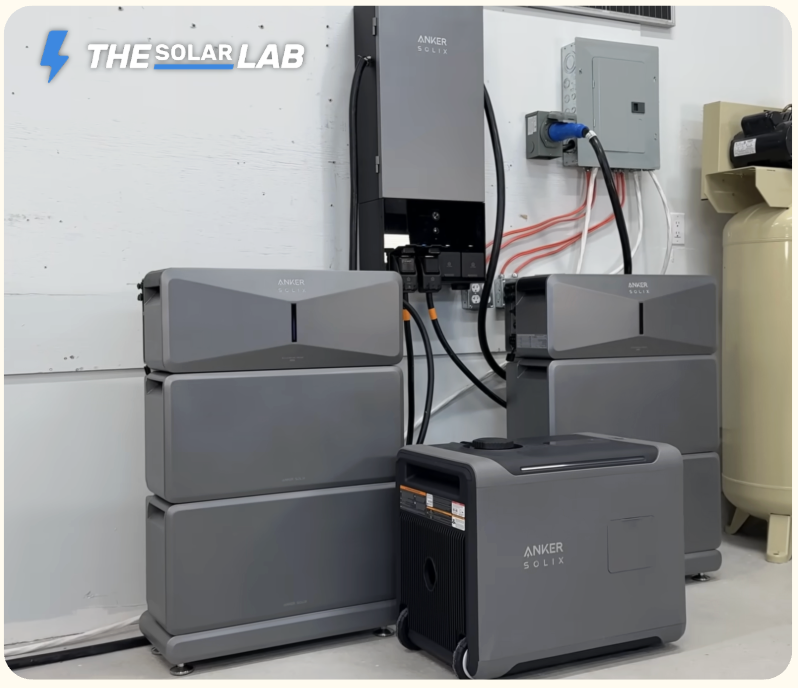
We wanted to test it it’s fully potential, so the bundle we got our hands on came with all of the following components:
When everything is connected, you’re working with roughly 25kWh of storage capacity, 15kW of continuous output, and up to 18kW of solar input capacity. On paper, this puts the Anker E10 system firmly into whole-home territory rather than just being your typical portable power station setup.
One of the biggest differentiators between the Anker SOLIX E10 system and competitors is how Anker approached installation and usability.
Most off-grid solar inverter systems require a fair amount of planning, wiring, and technical understanding. Even other modular power stations, like the EcoFlow DELTA Pro Ultra or the Bluetti Apex 300, require a reasonable amount of setup time. This E10 system takes the opposite approach.

Once the Anker Power Dock is installed, which is the only part that really requires electrical work, the rest of the system is almost entirely plug-and-play. In fact, it’s even simpler than plug-and-play, as there are very few plugs. Instead, most of the contact points connect wirelessly. You just stack the components, and then they click into place.
Basically, the E10 battery modules stack directly beneath the E10 Inverter Module. You can stack up to five of the 6.144kWh batteries to an inverter. Again, they snap into place wirelessly, and even the connection points between the Anker E10 and the Anker Power Dock are color-coded, which removes a lot of the guesswork.
It’s one of the few systems at this scale where someone without any electrical background could realistically get it up and running. Even the manual is very IKEA-like, meaning they use fool-proof images to explain the setup process, rather than complex text.
That simplicity a big part of the appeal, especially for homeowners who want home power backup without diving into a full multi-component DIY solar power system
Beyond the simplified design, where this system really starts to justify its price is in how it performs. On paper, each inverter is rated for just over 7,600 watts, but in real-world testing, the system goes well beyond that when you need it to
Running both inverters together, we were able to push around 21kW of continuous load in turbo mode, with surge performance climbing close to 30kW before the system tripped. That’s more than enough to handle demanding household loads like air conditioners, compressors, and multiple large appliances running at the same time.
This kind of performance is what separates a basic backup system from something that can genuinely function as whole-home backup power.
If you want similar performance, you’d realistically have to start looking at standalone inverters, like an EG4 FlexBOSS 21 Hybrid Inverter, which would be more complicated to install, and you’d have to worry about matching it with the right battery bank. With this Anker SOLIX E10 setup, everything was designed to work together seamlessly.
Now that you know what this setup comes with, and why it differs from other expandable power station systems, let’s take a look at some of the things we really liked about it:
One of the more underrated aspects of this system is how quiet it is. Instead of relying on fans, the Anker E10 Inverters use passive cooling through heat fins, which means there are fewer moving parts and almost no noise. Plus, it runs at a high voltage, which also helps cut down on the noise.
Even when we were forcing the inverters to surge way beyond their continuous output rating, the Anker E10 units remained whisper quiet.
Now, keep in mind the EcoFlow DELTA Pro Ultra that the E10 was designed to compete with is one of the quietest power stations we have ever tested. Somehow, Anker SOLIX was able to make something even quiet. That definitely feels intentional, and it’s a welcome feature for those looking for something they can install inside their home and forget about.
Even other Anker SOLIX power stations that use active cooling systems seem loud in comparison to the E10. Whether you install it directly inside your home, or want to set it up in the basement or garage, it’s pretty much going to be unnoticeable while it’s running.
The Anker SOLIX Power Dock isn’t just a connection point, it’s what makes this a smart backup power system. Through the app, you can prioritize circuits so that essential loads always have power during an outage.
In practice, that means if something that requires a lot of power, like a Tesla charger, tries to turn on while you’re already pulling power for something else, like running the oven, the system can delay it automatically. Basically, you choose which circuits get priority, so you never have to worry about overloading your system if you try to pull power from it while a different load is running.
That level of control is something you’d typically expect from a dedicated standby system like a Generac standby home backup generator, but with more flexibility and customization. Plus, you don’t have to worry about fuel if you’re charging the batteries with AC or solar power (although you also have fuel options if you incorporate the Anker Tri-Fuel Smart Generator into the mix).
Again, this is easily one of the most approachable systems we’ve ever installed, and we have set up more than our fair share of power stations and solar inverters.
The manuals are clear, visual, and genuinely very helpful. That is not something you can say about most of the resources you get from power station companies. Typically, they’re confusing instruction manuals that were clearly translated to English from Chinese.
Beyond that, the connection points are designed to be almost impossible to mess up. All of the wireless connections and the cables that connect the unit to the Power Dock are color-coded. Things only fit where they need to, and you pretty much could put this thing together just by glancing at a picture.
Beginner-friendly setup might seem like a small detail, but it makes a big difference when you’re setting up a system of this size, especially if you’re new to backup power.
From our perspective, the less intimidating brands can make these units, the more appealing they will be to the average person. That’s a really good thing when having a source of independent power is becoming more important than ever.
The inclusion of the Anker SOLIX Smart Generator 5500 gives this system a level of redundancy that most power stations don’t have.
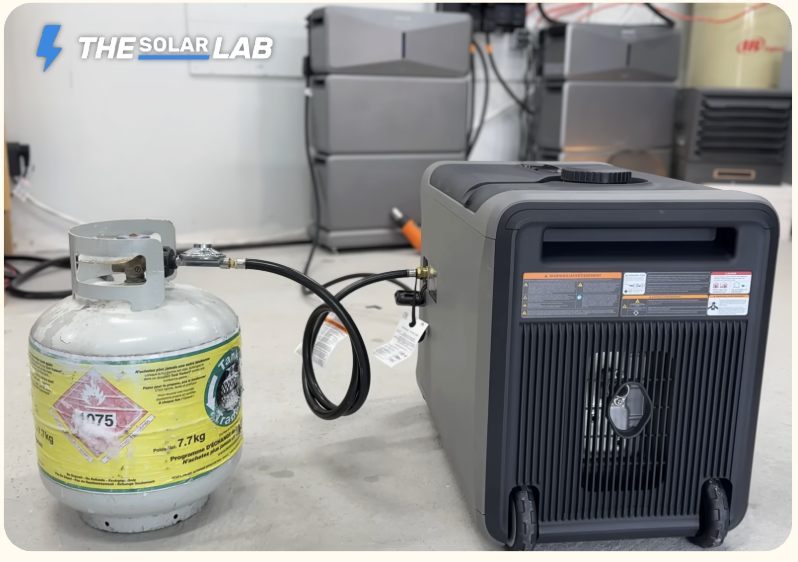
Because it can run on gasoline, propane, or natural gas, you’re not locked into a single fuel source. It also integrates directly with the system, automatically turning on and off based on your battery levels.
It can even identify how much fuel you have based on readings of your fuel type. For example, you can input the size of your propane tank, then it can come up with an accurate estimate of how long the system will run on that fuel.
One of the more impressive aspects is that it outputs DC power directly into the inverter, allowing you to charge the batteries while still pulling full power from the system. That’s something many AC-based systems struggle to do efficiently.
Honestly, this generator was one of the more impressive aspects of the entire setup. It could be because the EcoFlow Smart Generator 4000 caused us a few issues, but this Anker Smart Generator really stood out.
While there is a lot to like about. The Anker SOLIX E10 Whole-Home Backup System, it’s not perfect. The potential is definitely there, and we think it will fit the needs of a lot of users, but we think there’s room for improvement in the following areas:
The biggest drawback here is how isolated the system feels. While the wireless connections are undoubtedly really cool, it also means that everything is proprietary. That proprietary nature isn’t even just within the Anker SOLIX ecosystem, it’s specifically within the E10 lineup.
Even other Anker power stations and accessories, like the Anker SOLIX F3800 Plus, don’t integrate cleanly. While there are workarounds using AC connections, it’s not as seamless as it should be, especially for a system at this price point.
One of the more frustrating design decisions is that both solar and generator inputs connect directly to individual inverters instead of through the Anker Power Dock. This creates a situation where:
From a system design perspective, it would make far more sense for all inputs to route through the Anker SOLIX Power Dock so power could be distributed automatically.
If you try to run the Anker SOLIX E10 without a Anker SOLIX Power Dock or Anker Smart Inlet Box, you’re limited to basic 120V charging. For a system with this much battery capacity, that’s extremely slow and not very practical.
It’s clear that Anker SOLIX wants you to buy into the full ecosystem, and that kind of makes sense, as we feel most buyers will want to get the full potential out of this setup. However, it does make the standalone Anker SOLIX E10 and two batteries setup feel more limited than it should.
There are also a handful of smaller issues that stand out once you spend time with the system.
The Power Dock includes more ports than it can actually use, the generator doesn’t integrate where it logically should, and some components, like the Power Dock itself, are somewhat difficult to purchase on their own.
We also wish it had a built-in screen. Sure, it looks really clean and futuristic without one, and the Anker SOLIX app works really well, but the DELTA Pro Ultra has a display screen and a smart app, so why can’t the E10?
Individually, these aren’t major problems, but together they make the system feel like it’s still evolving. Hopefully, they’re issues Anker addresses with future versions of this system.
This system makes the most sense for someone who values simplicity and scalability over absolute efficiency or customization.
While it’s a bit pricey, we think it will really appeal to anyone that is looking for a home backup power system that offers the following:
Honestly, this is one of the most user-friendly options available right now. There are definitely cheaper alternatives, and some of the all-in-one solar kits offered through Signature Solar are way better deals, but everything about this system feels straightforward and premium.
It’s especially appealing if you don’t want to build a traditional off-grid solar inverter system from scratch but still want something that can grow into a serious setup over time.
And, if you want a truly hands-off setup experience, Anker even offers local installation, where they’ll set it up for you when they deliver it.
The Anker SOLIX E10 Whole-Home Backup System is one of the most ambitious power station setups we’ve ever tested. It delivers strong performance, excellent usability, and a level of scalability that makes it a legitimate whole-home backup power solution.
That said, it’s not without flaws. The proprietary design, input limitations, and a few questionable system choices hold it back from being an easy recommendation for everyone.
But if your priority is a plug-and-play backup power system that can handle real-world demands without requiring a complex installation process, this system absolutely delivers. For the right buyer, it’s not just a typical power station, it’s a complete and flexible alternative to traditional home backup systems.

We test solar products so you don’t have to. Check out our opinions and which units we think are worth your money and which ones aren't.
More Reviews >